21 February 2026
Philosophy
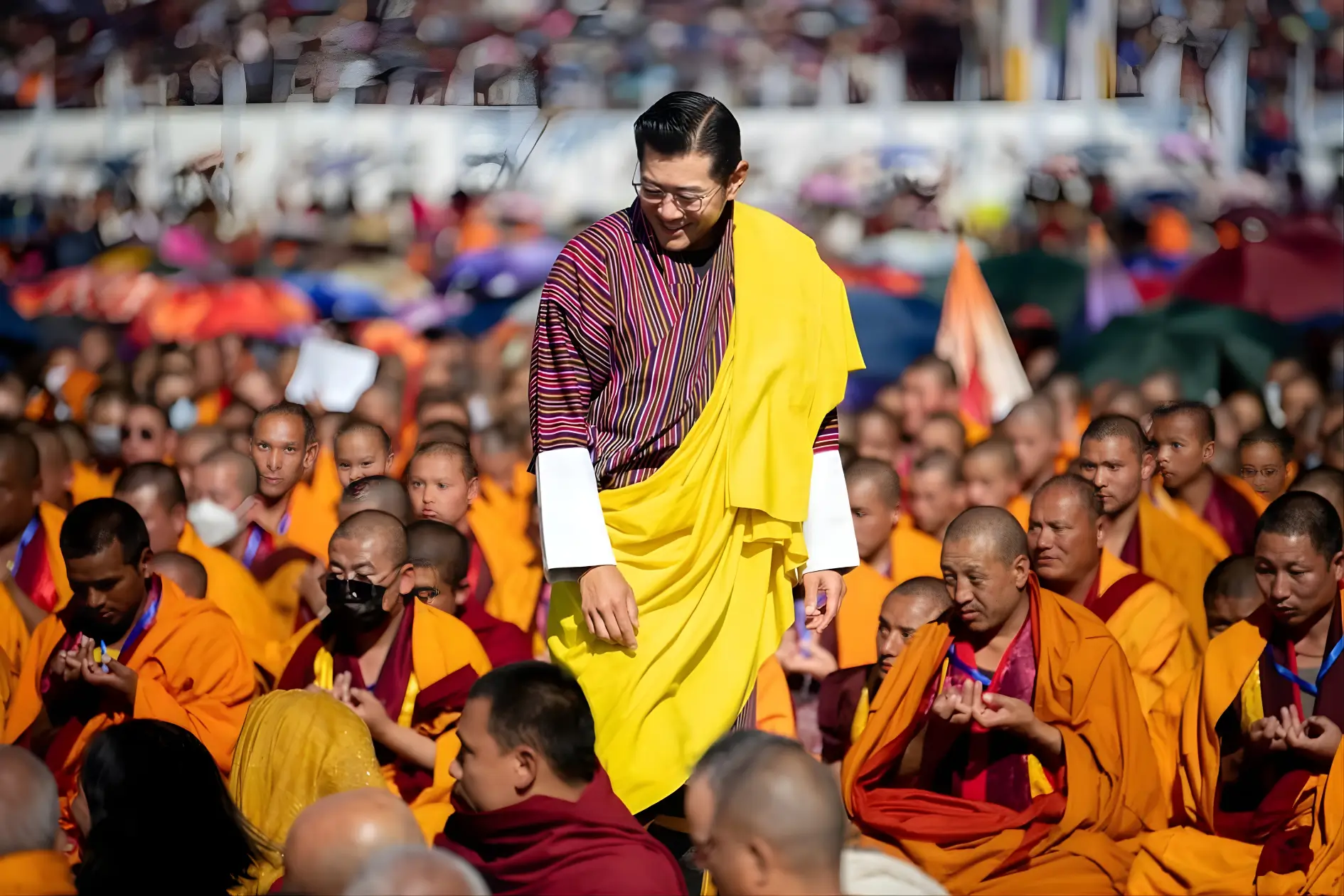
Today (07/10/2021) is an auspicious and indelible moment for all the students at Jigme Singye Wangchuck School of Law. We had been looking forward to this day for a very long time. Finally, it was here; a day one could only describe as truly extraordinary. The air was thick with tension and excitement as we watched His Majesty walk towards us. We bowed in awe and reverence.
His Majesty began by posing the first question, as he had asked students at other colleges in Bhutan: “How much value would you bring to your workspace? How would you benefit your country?” I recalled holding my tablet, facing the pine-laden hills stretching beyond my view from a large window in Taba. I needed serious contemplation. I could not help but marvel, remembering his profound speech; extraordinarily relevant to us today. What a visionary he is!
Forty Years, 14,600 Days: What Will You Do with Them?
His Majesty shared, “Most youngsters will be working beyond 2061. Given the small population of Bhutan and lower fertility rates, Bhutan’s demography will undergo a drastic change. On average, we will be working for 14,600 days—that is 40 calendar years.” He asked how we are going to stay relevant amid the changes taking place, what upskilling we would need, and how we will contribute to the vision he shared with us that day.
His Majesty brought up anecdotes about what is happening with our college graduates. He pointed out that when someone from CST graduates, they often find themselves in countries like Australia, the US, or Canada, working in cold storage facilities, hotels, or babysitting. His question was direct: “Are you practising what you have learned or trained for back at home?” He spoke with a concerned expression; and was, in fact, vocal about calling it what it is.
He reminded us that no matter where we go, be it Australia, Canada, the US, or any other country, if our profession is architecture, we should be architects there too. If we are engineers, we should work as engineers there too. He added that if we cannot work in the field we are trained for, there must be an issue that is pressing and significant. He questioned, “Is it because of our course modules, or is our standard different?”
If that is the case, then we must build our competence and capacity to be equivalent to, or even better than, theirs. That was exactly what His Majesty decreed.
Not by Default, but by Design: Choosing Our Own Future
His Majesty then shared his thoughts on change. He said that we have a very small population, an even smaller youth population, and very few people who are learned and competent. Nestled between China and India amid constant geopolitical rifts, we are not a rich country and have a very long way to go.
He advised us not to go on autopilot. “Our future must not be built by default but by design.” He reiterated, “Always by design,” so that we make conscious choices about how we would like our country to be in the near future as we carry the legacy forward into a new era that demands new ways of living and surviving. On this account, I came to the realisation that if we want different outcomes, we will have to approach our lives in fundamentally different ways. With the same choices, methods, steps, and energies of the past, we cannot expect different results.
He then transitioned to discussing the demerits of producing an excessive number of graduates beyond what the job market demands. He told us we cannot keep producing an excessive number of nurses or teachers when opportunity is scarce. It is worrisome because we cannot afford to produce disgruntled workers with compromised capacity and quality.
As I share this with readers, reflecting on His Majesty’s immense concerns, I feel deep within me a renewed determination and steadfastness to be of value. I imagine myself and my friends graduating with fresh zeal and enthusiasm to create impact. I am certain these feelings are valid, but I am realistically optimistic that there are limitless opportunities. Create one if there are none. Pursue one if alternatives exist.
As we listened to His Majesty’s concerns, I realised we must dream big and, at the same time, materialise those dreams through education and upskilling. He truly awakened the sleeping elephants within us through his most genuine speech, one that touched our hearts and painted a vision both compelling and clear. He taught us that we must dream so big, see the great potential in what we are doing, and back those dreams with “education, willpower, and tenacity.” He encouraged us to stir ourselves and go beyond our traditional, siloed existence.
Small Nation, Big Ambition: Why Bhutan Must Go Digital
His Majesty positively noted that since we are a small country with a modest population, we can leverage our size, create smart plans, and manage everything efficiently.
He provided one way of moving forward, among others. He said one critical aspect is that we must take advantage of technological advancement. We must realise the immense benefits of AI, blockchain, and quantum computing and harness them for our own advancement. His Majesty recognises and foresees complete digitalisation as one of the most important paths forward for Bhutan. In his own words: “It is not what we can do, but what we must do.” This means digitalisation is not optional; it is imperative. I became more assured that if we know what we must do, we will find a way to do it. For that purpose, His Majesty tirelessly and with great zest shares his visions with us, because he places his highest trust in us.
This was a stirring wake-up call for each one of us, regardless of caste, creed, background, or religious differences. He sees us as capable of carrying his vision forward. It is time we look deep within and find the compass that directs us towards what we are truly capable of, and make it happen. While contemplating this, I asked myself how I can contribute to this grand vision in a meaningful way. I must find a way, because we have heard and understood what we must do.
From his speech, I could envision how innovative and disruptive technologies are transforming working conditions and lifestyles around the world. His Majesty spoke at length about our upcoming National Digital Identity (NDI). He cited India’s Aadhaar cards as an example to draw inspiration from. He said they are inexpensive, implementable, easily accessible, and can be seamlessly integrated with multiple services. He further added that we could also look to Estonia, which has had notable success.
In order to implement this, we could have asked another country to develop it for us. Instead, His Majesty said we pondered upon it and asked the right question: “How many countries have a very strong digital ecosystem?” “Singapore, South Korea, and China. Can we be the fourth?”
For that, he said, we need to restructure from scratch, or change everything, to reach their level. We need to develop ourselves. We need to adopt end-to-end, scalable business models to build Bhutan’s legacy forward and strengthen our own economy. Most importantly, from this, I understood that we cannot depend on other countries for every grain of salt.
Building the Builders: From Code Monkey to Quantum Security
As for how we can achieve this, he shared his concerns about not having a sufficient talent pool. For this reason, he said we are going back to the fundamentals. He said we assessed the landscape and introduced Code Monkey (a coding programme for children) and prioritised science, technology, engineering, and mathematics (STEM). This effort aims to develop a talent pool from within; one that can create reliable and secure systems for Bhutan.
He further shared that we have established Gyelposhing College of Technology. The college has introduced robotics courses and a degree in blockchain technology; the first of its kind in the world. We have brought in expertise from abroad so that we can successfully materialise this vision. The students studying there are being trained to create our own systems. The NDI must seamlessly integrate with the judiciary, the civil registry system, banking, health, postal services, and everything that can be technologically utilised in real time.
In his vision for Bhutan, he called for an entrepreneurial mindset. His compelling vision is to take the NDI, and, of course, countless other ventures, to an IPO. He said that after our success, we can share our experiences with other nations like Mongolia, Afghanistan, and Turkey, and help them build theirs.
His Majesty then said that merely developing the NDI and other systems is not enough. He highlighted the idea of “Sovereign Identity.” He recalled George Orwell’s 1984, where, in an imagined future, the author forecast much of the world falling victim to perpetual war, omnipresent government surveillance, historical negationism, propaganda, fake news, and conspiracy theories. He asked us: How can we protect people’s identity, privacy, and security rights? He further asked us to develop a clear understanding of how much personal data a government should be permitted to use.
His Majesty positively envisions the NDI becoming a multi-million-dollar company, a unicorn built on Bhutanese experiences and values. Even grander, he affirmed that its success must stretch beyond our boundaries, from where we can take our experiences overseas.
We need to realise the potential of digital technology through practical support from experts. He further said that if we merely let the youth pursue IT courses, they will simply drift from pillar to post seeking jobs in corporate sectors with a salary of just Nu. 30,000. Everything we have, phones, watches, household appliances, essentially everything we use, has changed and evolved over time.
The biggest takeaway from the above is that our accomplishments are the result of the choices we make and pursue. Past successes are never a lasting comfort. Everything is dynamic and evolving because the tools we once used are no longer applicable to new endeavours. It would be a farce to plough fields with animals when others are conducting mass agriculture within a fraction of the time. We must keep pace with the world and develop imperative infrastructure for our own survival. We must have a grand and practical vision. Merely staying content with the mundane cycle of traditional work is not enough.
The NDI is just one example. He asked us to look for end-to-end models and receive relevant backend training, because we are competing with first-world countries like Singapore, the US, Japan, and South Korea, among others. When it comes to what we can do, he said, “Cost is the last thing on our mind.” He envisaged that we are looking at the end of the road. “What do we want to create?”
His Majesty’s visions are profoundly relevant and compelling. He said we want to build billion-dollar companies. We want to achieve quantum security. We want vendors to come and partner with us in advanced technology; in AI and blockchain to begin with. Are we up for it?
Sharp as a Razor: Competing on the World Stage
He expressed his concerns about engaging with other countries and multinational companies (MNCs). He said we cannot be naïve just because we have been protected in a shell, isolated for so long. How can we go for an IPO? At this moment, I realised there is so much to learn and so much to do.
His Majesty said, “Every time we engage with other countries, we will have to stand on our own feet, be as sharp as a razor, be smart, and understand every complexity involved.” If an issue arises in transactions and dealings, he asked, where can we take it? Which courts? Is it in Bhutan or is it in the UK? “If we go to the UK, do we know how to navigate those deep waters?”
His Majesty also reminded us that we are still in our infancy and, therefore, have so much to learn and more to prepare for. He said that our generation is not yet ready. We could have built the interest and expertise in what matters much earlier, when we were young. When we learn about AI, blockchain, and similar technologies only in college, we are suddenly thrust into a bewildering environment. He asked, “How can we compete with other countries when we are just learning the basics?”
Another central point he shared was that he wanted us to face difficulty and embrace discomfort. This, he said, will filter out the weak and fortify opportunities for those who are resilient and willing to grapple with complexity. He further said that if everything is easy, we will not move forward, and we will not be able to create change, innovate, or survive.
Complacency Kills: The Case for Relentless Excellence
It is high time we change the situation in our country. It is inevitable that many youths will go overseas to work. But this should not happen when we have so much more to do here. The industry, the companies, and the jobs we create must change. There must be aspirations for the future, and for that we need capacity; capacity built on education.
He asked again whether “good” is good enough for us. Whether “okay” is enough. If the answer is yes, then we must be prepared to accept “okay” results if all we choose to chase is mediocrity. Perhaps the most important takeaway here is that complacency kills, and we must strive for nothing less than excellence. For that to happen, we must take responsibility for our own education.
Citing the Dessups who were trained by chefs from high-end hotels, he said, “If your six months of training can set you up for life, then you will never go hungry. You will build something special and lasting for yourself and for your family.” He showed how proud he is of them and said, “The journey has just begun.” Likewise, the journey has just begun for us too. The success of each of us will depend on the legacy we leave and the impact we have in our own lives, in our communities, and, more ambitiously, what we can do for our country.
A Call to Arms for Bhutanese Lawyers : Can You Hold Your Ground?
For upcoming lawyers like us, he specifically said that we cannot afford to have an excessive number of lawyers, either. “If we want to go IPO, what expertise do we need? Can we, or could we have, saved the Punatsangchhu Hydropower Project?” I suddenly realised the expectations and hopes he has for us. I asked myself again: Are we up for it?
For the Gyalsung Project, he said, we will have to spend over 100 million dollars because we currently lack the expertise and talent pool to manage it. But eventually, Bhutanese professionals must take the reins. “While signing a contract on the project, can the Bhutanese go in blindly or ask the counterpart to draft the contract?”
He said that would be despicable, disgusting, blasphemous, and utterly foolish of us.
“When we establish a company in Singapore or Australia, can our Bhutanese lawyers represent us there? Can they hold their ground for us?”
He further added that it is not enough to merely understand Bhutanese law, pursue a Master’s degree at one university in Washington, DC, return home, and gradually climb the ladders in the judiciary. He said it is worrying if one’s sole aspiration is to earn a positional scarf and sword (Kabney and Patang). We must dream bigger, prepare for what is coming, and create an impact that can change the trajectory of where Bhutan is heading.
When we go IPO, scale DHI projects, build drone technology, or venture into quantum computing, he wants us to know how to protect our intellectual property (IP) rights, leverage our experiences, and take them further. He finally asked, “Would you be able to represent us in navigating the complexities involved?”
The Journey Has Just Begun
In the near conclusion of his thought-provoking speech, His Majesty told us that he cannot congratulate us next year, but he would say this: the journey has just begun. He expressed his hope that we will advance to Phase II and not stop there, that we will contribute in a meaningful way.
In his concluding note, he asked us to hold our breath, save our energy and enthusiasm, for we have a long way to go.
Thank you, Your Majesty, for that extraordinary day, for inspiring us, and for being an epitome of visionary leadership. We will always remember this and make sure that we dream big, work for it, and make it happen.
We agree, Your Majesty: Our journey has just begun.
Truly and Sincerely,
Tika R. Basnet
Proofread and edited by Tashi Norbu, and assisted by Tshedrup Zangmo.
Picture Courtesy: His Majesty’s Official Instagram Handle. Our North Star leading the way!
Addendum: Five Years On — The Vision Materialised
A reflection on what has changed in Bhutan since October 2021
Five years have passed since His Majesty shared that transformative vision with us in October 2021, and the pace at which Bhutan has moved is nothing short of remarkable. The National Digital Identity (NDI), which His Majesty spoke of as a dream to be realised, was launched nationwide in October 2023, less than three years after its conception. Bhutan became the first sovereign nation in the world to roll out a self-sovereign identity (SSI) system at a population scale, giving every citizen a secure digital wallet to store and share verifiable credentials. The system did not stop there. After initially being built on Hyperledger Indy, the NDI migrated to the Polygon blockchain in August 2024 and then, in October 2025, made history again by anchoring itself on the Ethereum mainnet, with Ethereum co-founder Vitalik Buterin personally attending the launch ceremony in Bhutan. With over 230,000 users, more than 40 integrated services spanning healthcare, banking, telecom, and judiciary, and a full credential migration to Ethereum expected by early 2026, the NDI has evolved from a bold idea into a living, world-leading digital trust ecosystem. It was even showcased at the World Bank Global Digital Summit in 2025 as a model of privacy-first public infrastructure.
His Majesty’s call for an entrepreneurial, technology-driven Bhutan has manifested most dramatically in the Gelephu Mindfulness City (GMC), a $100 billion Special Administrative Region announced on National Day 2023. Designed by the world-renowned Bjarke Ingels Group (BIG) and spanning 2,500 square kilometres, GMC operates under a “One Country, Two Systems” framework with its own business-friendly legal and regulatory structures. It aims to create 100,000 jobs by 2030 across eight pillar industries, including fintech, green technology, and wellness tourism. In December 2025, Bhutan launched the TER gold-backed digital token on the Solana blockchain through GMC, and in January 2025, GMC incorporated Bitcoin and Ether into its strategic reserves. Perhaps most strikingly, in May 2025, Bhutan partnered with Binance Pay and DK Bank (the nation’s first fully digital bank) to launch the world’s first national-level crypto tourism payment system; allowing visitors to pay for everything from visa fees to roadside fruit stalls using over 100 cryptocurrencies. With Bhutan now holding over 12,000 Bitcoin through green hydropower mining; making it one of the top government Bitcoin holders globally; His Majesty’s vision of building billion-dollar ventures is no longer aspirational; it is underway.
The talent pipeline His Majesty envisioned is also taking shape. The Gyalsung National Service programme, which His Majesty announced in 2019 and which he referenced in his 2021 address, was officially launched in September 2024 across four academies. By mid-2025, over 6,330 young Bhutanese had completed their training, including 56 who returned from overseas, emerging as “Gyalsups” equipped with military discipline, leadership skills, vocational training in areas like ICT and food security, and a shared sense of national purpose. Many are now volunteering to help build the Gelephu Mindfulness City itself, turning the King’s vision into bricks, code, and community.
Looking back at His Majesty’s words from that October afternoon in 2021, what strikes one most is not merely foresight but follow-through. Every thread he wove before us, digitalisation, sovereign identity, STEM education, entrepreneurial courage, global competitiveness, has since been pulled into something tangible. Bhutan has not simply listened; it has acted. And as we stand here five years on, the question His Majesty posed to us still reverberates with urgency and invitation: Are we up for it?
The evidence suggests that Bhutan, at every level, is answering with a resounding yes.